

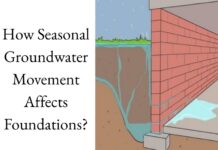



Groundwater levels aren’t fixed; they rise and fall with the seasons, due to rainfall, temperature, and human activity. These fluctuations significantly impact building foundations, often causing problems that aren’t immediately obvious in design. Ignoring these seasonal shifts can lead to long-term structural issues, from settlement to cracking. This article breaks down how groundwater movement affects foundations and what can be done to mitigate those effects.
How Groundwater Levels Change
Seasonal groundwater movement occurs predictably; wet seasons (monsoons or heavy rainfall) cause water tables to rise as water infiltrates the soil. Dry seasons lower them through evaporation, drainage, and reduced recharge.
Human factors, like irrigation leaks, construction dewatering, or nearby excavations, can also disrupt groundwater conditions locally. The rate of change depends on soil permeability – how easily water flows through it.
Why this matters: Foundations are designed based on soil conditions. When those conditions change unexpectedly, structures can experience stress beyond their design limits. This isn’t just a theoretical concern; it’s a major cause of structural distress.
The Impact on Soil Behavior
Groundwater changes directly affect soil strength and volume. The key factors:
-
Effective Stress: Soil strength depends on effective stress – the pressure soil particles bear after accounting for water pressure. Rising groundwater increases water pressure, reducing effective stress and weakening the soil. Conversely, falling groundwater increases effective stress, but can cause volume changes in certain soils.
-
Expansive Soils: Clayey soils shrink and swell with moisture. Rising water expands them, potentially lifting foundations, while drying shrinks them, causing settlement. This repeated cycle causes differential movement: one part of the foundation settles more than another, leading to cracks.
-
Erosion & Loss of Support: Seasonal groundwater flow can erode fine particles from sandy or silty soils, creating voids beneath foundations. This weakens support and causes uneven settlement, especially near slopes or drainage paths.
Shallow vs. Deep Foundations
Shallow foundations (footings, rafts) are more vulnerable to groundwater changes. High water levels reduce their bearing capacity – the ability to support weight. If a foundation was designed assuming dry conditions, excessive settlement or failure can occur. Uneven groundwater distribution causes differential settlement between footings, leading to cracks.
Deep foundations (piles, piers) are generally less affected, but not immune. Rising water reduces friction along the pile shaft, lowering its capacity. Conversely, soil consolidation due to falling water creates negative skin friction, increasing load on the pile. Groundwater flow can also erode soil around pile caps, weakening support.
Common Signs of Groundwater-Related Foundation Distress
Engineers often see these symptoms:
- Seasonal wall cracks that open and close.
- Uneven floors.
- Jammed doors/windows during wet seasons.
- Structural element separation.
- Dampness or seepage near the foundation.
These may start small but indicate ongoing soil movement.
Design & Mitigation Strategies
To address seasonal groundwater effects:
-
Detailed Site Investigation: Geotechnical studies must consider seasonal fluctuations, not just a snapshot. Historical data, drainage patterns, and nearby water sources are critical.
-
Conservative Bearing Capacity: Design calculations should assume worst-case groundwater conditions unless proper drainage is guaranteed.
-
Effective Drainage: Subsurface drainage systems and proper site grading are often more effective than structural reinforcements.
-
Foundation Depth: Placing foundations below the active moisture zone minimizes impact, especially in expansive soils.
-
Foundation Type: Raft foundations distribute movement better, while piles transfer loads to stable depths.
Ground improvement techniques, like soil stabilization, replacement of expansive soils, compaction grouting, and geotextiles, can also help.
Conclusion
Seasonal groundwater movement is a critical factor in foundation performance. Ignoring it leads to avoidable structural issues. Thorough site investigation, conservative design, and effective drainage are essential for building durable structures. Addressing groundwater effects proactively saves money and ensures long-term stability.