





Grilling isn’t just a hobby. It is a fundamental way we cook food outdoors. The goal is simple. You want high heat. You want flavor. You want those blackened char marks that signal a job well done.
At its core, a grill is a machine for burning things. It has a cooking surface. That surface is usually parallel metal bars or a porcelain-coated grid. Below it sits a fuel source. That fuel generates intense heat. We are talking temperatures up to 500 degrees Fahrenheit or more.
Two types dominate the backyard. Gas and charcoal. They are the most common for good reason.
This guide breaks down exactly how they work. We will dissect the charcoal grill. We will look at what charcoal actually is. And we will separate liquid-propane from natural-gas systems.
Let’s start with the basics. The humble charcoal grill.
The Simplest Grill Design
Grill components range from basic to overly complex. You can buy a stainless steel behemoth with temperature probes and side burners. Or you can use a bucket.
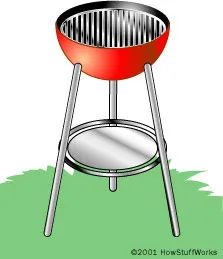
The simplest version is a charcoal burner. It has only three parts.
- Cooking surface
- Charcoal container
- Grill support
Think of a shallow, round metal container. Place it on a tripod. Put a round grill grate on top. That’s it.
This design works because it maximizes airflow. The charcoal sits in the container. The grate sits above. The air moves through the fuel. The heat rises. The food cooks.
It doesn’t get much simpler than that.

The Evolution of the Grill
Charcoal grills can get complicated. Some models feature a hood to trap heat and tiered cooking racks for multi-level meals. But at its core, the mechanism remains unchanged.
The fuel source has existed for at least 5,000 years. No one knows who first discovered charcoal or which civilization pioneered its use. Archaeological evidence of charcoal appears globally. Ancient Egyptians even used it during the embalming process for mummies.
It’s Just Wood, Refined
You might assume charcoal is a mineral or a form of coal. It isn’t. Charcoal is wood.
The process involves heating wood to high temperatures in the absence of oxygen. You take wood, seal it in a steel or clay container, and heat it to roughly 1,000 F (538 C).
Why bother with this tedious method instead of just burning fresh wood?
Freshly cut wood is heavy with moisture. Sometimes more than half its weight is water. Seasoned wood—left to dry for a year or two—contains less water. Kiln-dried wood has even less. But wet wood cooks inefficiently. It steams food rather than searing it.
Charcoal is wood heated to high temperatures in the absence of oxygen.
The Hidden Chemistry
When a tree was alive, its cells held sap and various volatile hydrocarbons. “Volatile” means these compounds evaporate when heated. Burning raw wood releases these compounds as thick, acrid smoke and ash. It burns hot and fast but leaves a lot of residue.
Removing oxygen during heating drives off the water and volatile compounds. What remains is nearly pure carbon. Pure carbon burns cleaner. It burns hotter. It provides steady, controllable heat for grilling.
This is why charcoal works better than raw logs. It eliminates the variables of moisture and sap. You get consistent heat. You get less smoke. You get better flavor control.
The process seems excessive until you taste the difference.

The Science Behind Charcoal’s Clean Burn
When you toss fresh wood or paper onto a hot fire, that thick gray plume you see isn’t just burning wood. It’s volatile hydrocarbons evaporating from the material. These compounds start vaporizing at roughly 300 F (149 C). If the heat gets high enough, those vapors burst into flame. Once they catch, the smoke stops. The hydrocarbons turn into carbon dioxide and water vapor, both invisible to the naked eye.
This is exactly why you see almost no smoke from a charcoal fire or a bed of embers. The intense heat drives off all volatile organic compounds. What remains is pure carbon and ash —the non-burnable minerals from the tree cells. When you light charcoal, you aren’t burning wood. You are burning pure carbon. It combines with oxygen to produce carbon dioxide. The only thing left at the end is ash.
This process creates intense heat with minimal smoke. That makes charcoal an ideal cooking fuel. It won’t overwhelm your food with the complex, sometimes bitter elements found in normal wood smoke.
Gas vs Charcoal Flavor Profile
Grilling enthusiasts argue constantly about the merits of charcoal versus gas grilling. They cite especially the difference in flavor. Charcoal provides a distinctive taste that is difficult to reproduce. It is a tough decision for many people: the convenience of a gas grill against the superior flavor of charcoal.
But let’s look at gas grills. How do they work? And can they truly compete with the char?