

Flying carpenter ants mean trouble. They are reproductive adults looking to start new colonies. And they love wood. Your home, specifically.
If you see them, act fast. Ignorance is expensive.
ID-ing the Invaders
These ants are giants in the insect world. At least in the U.S. Winged ones? They shed the wings after mating. They find a nook. A niche. A wall stud. Then the real work begins.
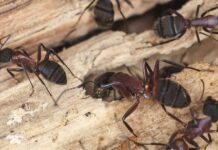
You probably won’t see the queens first. They hide. They can be two or three times the size of workers. Creepy, really. The guys flying out are the same size as the ground troops—maybe an eighth of an inch, up to half.
Color? Black. Dark brown. Sometimes a splash of reddish-orange or yellow, if they’re feeling festive.
Look closely at the wings. The front set is longer than the back set. Not equal. That’s how you know they aren’t termites. Termites have symmetrical wings. Carpenter ants are asymmetrical. Also, watch the thorax. It’s rounded. Smooth. Like a bridge.
Termites vs. Ants
Confused? You should be. Both ruin houses. Both fly. But the details matter.
- Wings: Carpenter ants wear yellow-tinted wings. Termites go stark white. And termite wings? Bigger. Proportionately huge.
- Antennae: Ant antennae bend. Termites’ are straight and short.
- Waist: Ants have pinched waists. Segmented bodies. Termites? Tube-like. Straight from head to tail. No curves.
- Light: Ants don’t mind the sun. They fly day or night. Termites hate light. They hide.
- The Eating: Termites eat the wood. They consume it. Carpenter ants? No. They move it. They chew out galleries with those massive mandibles. They eat protein. Sugar. Syrup. Honeydew. The wood is just real estate to them.
The Sound of Decay
Listen. Do you hear a soft crackling? Inside the walls? That’s bad news.
Or maybe you see piles of sawdust. Frass. It looks like sawdust. Because it is. Excavated wood debris.
If you spot wings. Big ants. This kind of noise. Call a pro. Now. Before the satellite colonies multiply. Before the parent nest collapses into sound wood.
They prefer rot. Dampness. Dead stumps in your backyard. Old firewood piles. But damp indoor wood? That’s next. They expand. They tunnel. They take over.
You can’t sting, but you can bite. Hard. They spray formic acid too. It burns. Just for the fun of it? Maybe. Mostly because you interrupted their Tuesday.
Killing the Colony
Baits help. Sprays mask the problem. They kill what you see. Not what hides.
You need the source. The nest. Otherwise, it’s a game of whack-a-mole with infinite moles. Find the entry. Trace the pheromone trails. Treat the hub.
Or they’ll come back. And bring friends.