




Flush the handle. The water swirls. The waste disappears. That’s the easy part. The hard part? What happens next.
Billions of gallons of wastewater flow through pipes every single day. We don’t think about it. We shouldn’t have to. But understanding the system helps you avoid the mess when things go wrong.
Why We Can’t Just Dump It Outside
You might wonder why we don’t just let wastewater soak into the ground or flow into a nearby creek. It seems like a natural solution.
It isn’t.
Raw sewage is a hazard. Here is why releasing it directly into the environment is a bad idea.
- The smell. It stinks. Bad. Fast.
- The bacteria. Human waste contains coliform bacteria like E. coli. These cause disease. Infected water becomes a health risk.
- The chemical damage. Wastewater has nitrogen and phosphates. These act like fertilizer for algae. Too much algae blocks sunlight. It fouls the water.
Decomposing organic matter sucks oxygen out of the water. Fish die. Suspended solids make the water murky. Fish can’t breathe or see. The ecosystem collapses.
No one wants to live in a stinky place with dead fish. That is why communities build treatment plants. That is why laws exist against dumping raw sewage.
The Septic Tank Alternative
Not every house connects to a public sewer. Rural areas often space houses too far apart. Laying miles of pipe is too expensive.
Homeowners use private treatment plants. They are called septic tanks.
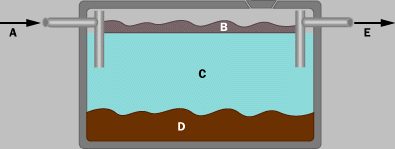
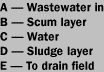
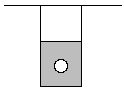
A septic tank is a buried concrete or steel tank. It holds about 1,000 gallons of water. Wastewater flows in at one end. It leaves at the other.
“Wastewater flows into the tank at one end and leaves the tank at the other.”
The tank sits underground. It looks like a box in cross-section. It’s the first step in private waste management.
How does the waste separate inside that box? That’s the next piece of the puzzle.
Why Your Septic Tank Splits Into Three Layers
You walk past the tank. You think it’s just a big black box buried in the ground. It’s not. It’s a settling chamber. A biological reactor. A stratified system that relies on gravity and time to do the heavy lifting.
Look at what happens inside.
Three distinct layers form. Always. Unless you pump it out too often or overload it with chemicals that kill the bugs.
The scum layer sits at the top. Grease. Fats. Oils. Soap scum. Stuff lighter than water. It floats. It creates a crust. If you’ve never seen it, imagine a thick, oily film on a bowl of cold soup. That’s what’s floating on your sewage.
The sludge layer sinks to the bottom. Solids. Particulates. Human waste. Stuff heavier than water. It accumulates. It compresses. If you don’t pump it, it fills the tank. Then it backs up into your house. A messy, expensive problem.
The middle layer is the effluent. Clear water. Mostly. It’s not potable. Never drink it. But it’s free of solids. It contains bacteria. It contains nitrogen. It contains phosphorus. It’s fertilized wastewater. That’s the layer that flows out to the drain field.
How Wastewater Enters the System
The house doesn’t just dump waste into the void. It enters through sewer pipes. Main stack. Branch lines. All converging into the tank inlet.
The flow is continuous. Showers. Toilets. Dishwashers. Laundry.
The water rushes in. The solids drop. The grease rises. The clear middle settles.
This isn’t magic. It’s physics. Gravity separates the masses. Density dictates position.
If the water stays in the tank long enough, the separation holds. If it moves too fast, the solids carry over. The drain field clogs. The yard floods. The repair costs triple.
The Chemistry of the Middle Layer
That middle water isn’t empty. It’s teeming.
Bacteria are working. Aerobic and anaerobic strains. They break down what’s left. They convert ammonia. They stabilize the pH.
Nitrogen and phosphorus remain. These aren’t just waste products. They’re nutrients. Fertilizers.
When this effluent reaches the soil, these nutrients feed the grass. The trees. The garden.
It’s a cycle. Waste becomes resource.
But only if the layers stay separated. Only if the tank is sized correctly. Only if the hydraulic loading rate is respected.
Why Maintenance Matters
Most people ignore the layers. They assume the tank handles itself.
It doesn’t.
The scum layer thickens. It encroaches on the outlet baffle. The sludge layer rises. It hits the same baffle.
Once the layers mix, the system fails.
Solids enter the drain field. They clog the perforated pipes. They block the soil pores.
You’ll smell it. You’ll see it. You’ll pay for it.
Pumping removes the sludge. It skims the scum. It resets the stratification.
Don’t wait for the alarm. Don
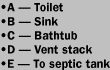
That rotten-egg stench? It’s real. Inside your tank, bacteria are busy eating away at organic waste, and the byproduct is a cocktail of gases that you definitely do not want in your living room.
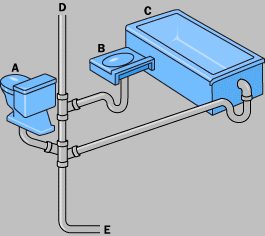
That’s why every sink has a P-trap. It’s that U-shaped pipe under the basin. It holds a small amount of water to create a seal. A physical barrier. The gases try to rise, hit the water, and bounce back down into the tank. Instead of coming into your kitchen, those gases take the easy path upward. They travel through a vent pipe.
Look up at your roof. You’ll see those PVC pipes poking out. They’re not decorative. They’re your house breathing out.
The Flow Out
Once the tank fills up, new wastewater pushes the older liquid out. It doesn’t stop at the tank. That displaced water flows straight into the drain field.
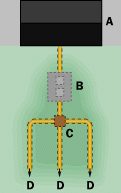
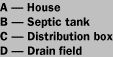
This is where things get tricky. The drain field is essentially a network of perforated pipes buried deep in gravel-filled trenches. The soil filters the liquid. The gravel helps distribute it. If you’re standing on your roof looking down, you might visualize the layout:
House > Septic Tank > Distribution Box > Perforated Pipes > Gravel Trenches > Soil
The diagram above gives you the overhead view. It’s a system of redundancy. If one pipe clogs, the water finds another path. But if the whole field fails? You’re dealing with a much bigger problem than a bad smell.
Why This Matters for DIYers
You might think this part of the system is “out of sight, out of mind.” It’s not. The P-trap is maintenance-light. Just keep it full of water. If a guest house sits empty for months, the trap dries out. The seal breaks. The smell returns.
The drain field is different. You can’t fix a clogged line from the inside. You can’t snake a perforated pipe buried under six feet of soil and gravel. That’s why proper usage matters. Don’t dump grease. Don’t use harsh chemicals that kill the bacterial colony in the tank. If the bacteria die, the solids don’t break down. They clog the drain field.
And once that clog happens? It’s usually a full replacement job. Not a quick fix.
Signs of Trouble
If you start noticing soggy spots in the yard, even in dry weather, the drain field might be backing up. Or worse, it’s failing entirely. The water has nowhere to go but up. Or sideways. Into your basement.
It’s a subtle thing at first. A faint sulfur smell near the drain field cover. Then maybe some slow drains upstairs. By the time you see gurgling in the toilet, the system is already stressed.
Keep an eye on the vent stack too. If it’s blocked by leaves or ice, the gases have nowhere to escape. Pressure builds in the tank. You might hear glugging in the sinks. That’s air fighting its way out through the water in your P-traps. It’s not fun.
The Bottom Line
Your septic system is a balance of biology and physics. Bacteria eat. Water displaces. Gravity pulls. Vents release.
How Deep Are Septic Drain Field Pipes
Most drain field pipes are standard 4-inch diameter PVC. That is about 10 centimeters. But the depth matters more than the pipe size itself. You are looking at trenches that dig down 4 to 6 feet. Roughly 1.5 meters. The width is tighter. About 2 feet. Or 0.6 meters.
The construction is layered.
- Bottom layer: gravel. This fills the bottom 2 to 3 feet of the trench.
- Middle layer: the pipe. It sits on top of the gravel bed.
- Top layer: soil. Dirt covers the gravel completely.
The gravel acts as a filter and support system. The soil seals it in.
This setup keeps the waste water contained while it percolates into the ground. If you are digging this yourself, check local codes. Depths vary by climate and soil type. Frost lines can push that 4-foot minimum higher in cold regions.
How Soil Dictates Drain Field Size
The ground does the heavy lifting in a drain field. It absorbs the water and filters out the remaining solids. This process is entirely dependent on soil permeability. If you have hard clay, water moves slowly. The system compensates by requiring a larger drain field to handle the same volume of wastewater. Sandy soil allows faster absorption. The footprint of the field shrinks.
This is all gravity-driven. There are no pumps pushing water from the house to the septic tank, and none pushing it from the tank to the drain field. It is a passive system. If the lines slope correctly, the water flows downhill. If they don’t, you have a backup. Simple physics.
The Greenest Grass Grows Here
You have probably heard the saying about grass being greener over a septic tank. The saying is wrong. It is the drain field that gets the verdant treatment. The soil there is rich with moisture and nutrients. Nitrogen and phosphorus from the wastewater act as natural fertilizer. The grass grows thick and dark green. It is not a sign of a leak. It is a sign of a functioning distribution system.
Urban Wastewater Systems
When density increases, individual septic systems fall apart. You cannot dig a drain field on a lot shared by ten other houses. Urban and suburban areas pack people closer together. This creates a massive volume of wastewater that needs centralized treatment.
Communities build sewer systems to handle the load. These pipes collect wastewater from thousands of homes. They transport it to a wastewater treatment facility. There, the water undergoes mechanical and biological processing before being released. It is not just filtration. It is a complex industrial process designed to remove pathogens and contaminants that a septic system would never touch.
The Geometry of Safety and Sewer Gravity
It is easy to walk past them without thinking. A heavy iron circle set flush with the pavement. But the shape isn’t an aesthetic choice. It is a survival mechanism. If a manhole cover were square, it could easily be tipped diagonally and fall straight into the void below. A circle cannot do that. No matter how you rotate it, the diameter stays the same. The cover stays on top. The worker stays safe.
This simple geometric fact masks a much more complex engineering reality.
Most municipal sewer systems rely entirely on gravity. Think of it like a natural drainage ditch, but buried underground and lined with concrete or clay. Pipes from individual homes connect to a larger sewer main running along the street. These mains are massive, often measuring 3 to 5 feet in diameter. They don’t just sit there. They flow downhill.
Every so often, you will see a vertical pipe rising from this main to the surface. The opening is capped by a manhole cover. These structures provide the only entry point for maintenance crews. Without them, the system would be a sealed black box. You wouldn’t know about the blockage until the basement flooded.
The shape of a manhole cover is dictated by physics, not fashion. A circle cannot fall through its own opening.
Where Does the Water Go?
The flow doesn’t stop at the street main. It converges. Smaller lines merge into bigger ones, creating a network that funnels wastewater toward a central point. That point is the wastewater treatment plant.
Engineers don’t place these plants randomly. Location is critical. To keep the gravity-fed system working efficiently, the plant is almost always situated in a low-lying area. The main lines often trace the path of old creekbeds or stream valleys. Water follows the path of least resistance. By following the natural downward slope of the land, the system minimizes the need for mechanical assistance.
But the land rarely cooperates perfectly.
When Gravity Fails
Hills exist. Elevation changes occur. When the natural slope runs out, the sewage has nowhere to go unless something forces it upward.
In these scenarios, the system incorporates grinder-pumps or lift stations. These are mechanical workhorses. They take wastewater that is stuck at a lower elevation and pressurize it, pushing it up and over the hill to reconnect with the gravity-flow network.
A grinder-pump is often used for individual homes or small clusters. It shreds solids into a slurry that can be pumped easier. A lift station is larger, handling the flow of an entire neighborhood or district.
The difference between a passive gravity system and an active pumped system comes down to topography. If you live in a valley, your waste likely flows freely. If you live on a plateau, you are probably paying for the energy it takes to lift your wastewater to the next downhill grade.
Primary Treatment Basics
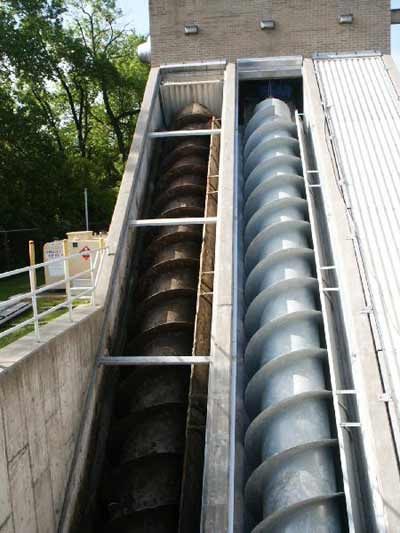
Once the wastewater arrives at the plant, screw pumps move it into the first phase of cleaning. This is primary treatment. It mimics a septic tank. Solids drop to the bottom. Scum floats to the top.
The system collects those solids. You usually send them to a landfill. Or an incinerator.
This stage is simple. You just need a screen. Then a set of pools. Let the water sit. Gravity does the work. Solids settle out. The water moves on.
The primary screen
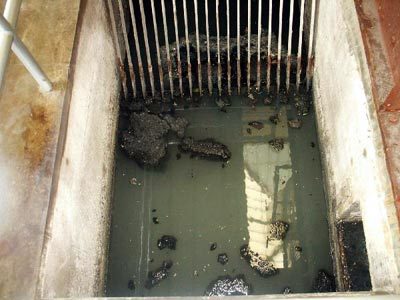
Raw sewage hits a physical barrier first. The primary screen acts as the first line of defense. It catches large debris. Rags. Plastics. Things you shouldn’t flush. This keeps the pumps from seizing up later on.
Primary clarifiers
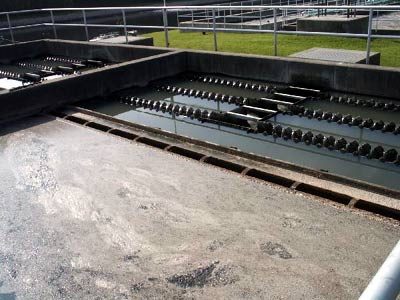
After the debris is gone, the water moves to primary clarifiers. Gravity takes over here. It’s slow. It’s simple. Solids sink to the bottom. Scum floats to the top. The process removes about half of the suspended solids and organic material. Bacteria go with them.
If the plant stops here? It’s not much of a purification step. The water still holds a lot of pathogens. So, before discharge, chlorination kicks in. This kills the remaining bacteria. It’s a quick fix. It’s not a complete solution. Most modern plants go further.
Secondary treatment
This is where the real work happens. The secondary treatment stage targets the stuff the first step missed. Organic materials. Nutrients. The goal is to break these down.
How? Bacteria. Not the kind in your gut. The kind in large, aerated tanks. The water flows into these massive vats. Air is pumped in to keep the oxygen levels high. The bacteria feast on the waste. They consume everything they can. It’s a biological eat-a-thon.
Once the bacteria have done their job, the water moves on. But you’re still left with a bunch of bacterial biomass. That’s the next problem. You have to separate the eaters from the eaten.
Where the Heavy Lifting Happens
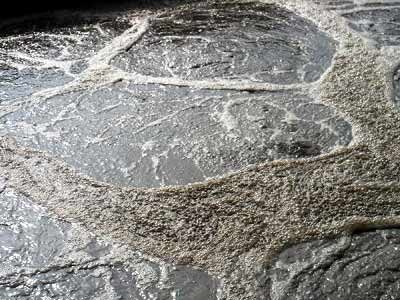
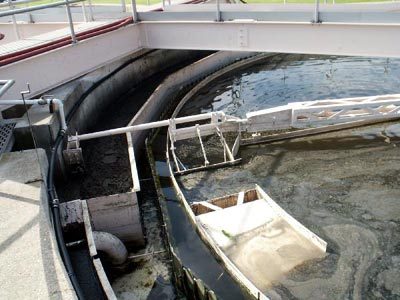
The flow doesn’t stop there. It moves from the aeration tank into settling tanks. This is the physical separation phase. Here, gravity takes over. The bacteria, which have been working overtime eating up waste, clump together and sink to the bottom.
This stage is critical. It’s known as secondary treatment. The goal is clean separation. The results are stark. This process can strip out 90 percent of all solids and organic materials from the wastewater. That is a massive reduction in pollution. What remains is significantly clearer, though not yet safe for release. The heavy lifting is done. The water is lighter.
The Final Polish: Tertiary Treatment Explained
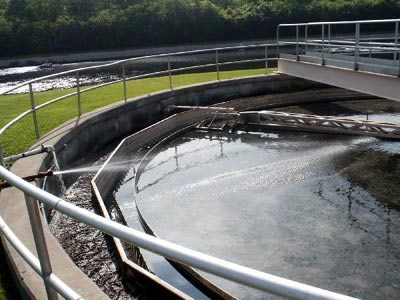
You have made it through primary settling and secondary biological breakdown. The water is clearer, but it is not yet safe to return to the environment or reuse. This is where the process gets specific. It is called tertiary treatment.
There is no single universal standard. What works for a dense urban center might be overkill for a rural community. The goal depends entirely on local regulations and what the receiving water body can handle. But the chemistry remains consistent.
Removing the Nutrients
Primary and secondary stages handle solids and organic matter. They do not always catch dissolved nutrients. That is a problem. Too much phosphorus and nitrogen in lakes or rivers causes algae blooms. These blooms suck oxygen out of the water. Fish die. The ecosystem collapses.
To stop this, facilities add specific chemicals. These agents bind with the phosphorus and nitrogen. The particles clump together. They become heavy. They sink out of the suspension. Some plants use sand filters or membrane filters to physically trap these particles. It is a mechanical and chemical sieve.
Killing the Rest
The water may look crystal clear. It still contains bacteria. Viruses. Pathogens. You cannot see them. You cannot drink them. So, the final step is disinfection.
Chlorine is the most common choice. It is cheap. It works fast. It leaves a residual effect that keeps pipes safe. Ozone or ultraviolet light are alternatives, but chlorine remains the industry workhorse.
Once the chlorine hits, the clock starts. The microbes are neutralized. The water is discharged. It is cleaner than when it entered the plant. It is safe for the river. It is ready for the next cycle.
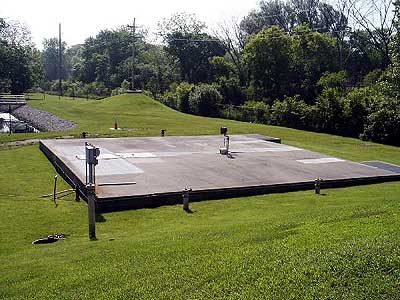
Checking the Output Quality
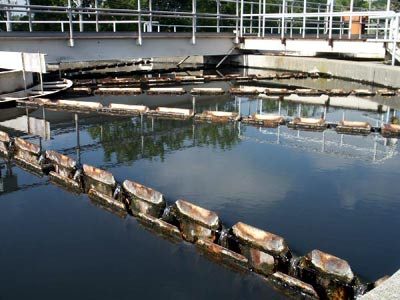
You don’t need a lab coat to understand why your local treatment plant matters. The water leaving the facility has to pass a series of strict checks. If it fails, the ecosystem downstream takes a hit. Here is how engineers measure success.
pH levels are the first thing on the list. This measures acidity. The goal is to match the pH of the natural water body receiving the discharge. A river or lake has a specific balance. The plant water should fit right in.
BOD stands for bio-chemical oxygen demand. It sounds technical but it is simple math. It measures how much oxygen bacteria need to finish eating the organic waste left in the effluent. If BOD is high, the water is still dirty. Ideally, this number sits at zero.
Then there is dissolved oxygen. This is the oxygen actually floating in the water as it exits the pipes. If it is zero, aquatic life dies. Period. The dissolved oxygen level needs to be high. It must exceed the BOD. Otherwise, you are starving the local fish.
Suspended solids are the visible debris. Cloudiness. Silt. Grit. After all the treatment cycles, these should be gone. Ideally, zero remains. If you can see particles, the filtration failed.
Nutrients are next. Total phosphorous and nitrogen are tracked closely. Too much of these causes algae blooms. Algae blooms kill oxygen. It is a vicious cycle.
Chlorine usage is another checkpoint. Plants add chlorine to kill pathogens. But you cannot dump raw chlorine into a river. It kills the good bacteria too. The chlorine must be removed or neutralized before release. It should be undetectable.
Coliform bacteria are the final red flag. This measures fecal matter. The target is zero. In the wild, you will always find some. Birds drop waste. Wildlife wanders in. But the discharge itself should be clean.
Why watch these numbers so closely? Volume. A single community produces millions of gallons of waste daily. We are talking 10 million to 100 million gallons per day. That is 38 million to 380 million liters. Every drop counts. A small error at the plant becomes a massive pollution event downstream.
Related Content
If you are interested in the mechanics behind these systems, look into how toilets work. Or how landfills manage waste. Water towers are another piece of the puzzle. Understanding house construction helps too.
For more specific data, check out resources on the occurrence of fecal coliform bacteria. There are also photo galleries of treatment plants online. If you have your own well, shock chlorination is a key safety step. For home renovation tips, guides on new home building and remodeling are useful starting points.